Why nobody can quote a fair number sight unseen
A fair price depends on what the water touched, how long it sat, and what has to be rebuilt afterward. Two homes with the same size leak can end up far apart. One had clean water caught early and the other had water that soaked into drywall and subfloor for days.
That is why this page gives no dollar figures. Any single number quoted over the phone is a guess. A reliable price comes after an inspection with moisture meters and a thermal imaging camera, followed by a written scope.
What you can do is learn the drivers. Once you know them, an estimate stops being a mystery and becomes a list you can read.
Mitigation and repair are two different bills
Water damage work usually happens in two phases. Mitigation is the emergency work: extracting water, removing wet materials that cannot be saved, and drying the structure. Repair is the rebuild: new drywall, texture, paint, trim and flooring.
Mitigation is time sensitive and equipment heavy. Repair is material and labor heavy. They are often priced separately, and sometimes done by the same company, as with water mitigation followed by rebuild work.
Ask any company to separate the two on paper. When a single lump sum covers both, you cannot see what you are paying for or compare it with another bid.
Driver one: the water category
The ANSI/IICRC S500 standard sorts water into three categories. Category 1 is clean water from a supply line or tap. Category 2 carries significant contamination, such as washing machine discharge. Category 3 is grossly contaminated, including sewage and rising surface water.
Higher categories cost more because the work changes. Porous materials like carpet, pad and drywall in Category 3 are removed, not dried. Crews add protective equipment, disposal and sanitizing steps. A clean-water leak that is caught early can sometimes be dried in place, which keeps demolition small.
Category can also worsen with time. Clean water that sits long enough can degrade, so early action keeps a loss in the cheaper column.
Driver two: area, materials and drying time
The affected area sets the scale. More wet rooms means more air movers, more dehumidifiers, more demolition and more rebuild. Water also travels, wicking up drywall and under baseboards, so the wet area is often larger than the visible stain.
Materials matter as much as area. Drywall and carpet are relatively simple to replace. Hardwood can cup when it absorbs water and may need to be dried slowly or replaced. Cabinetry, built-ins and insulation add labor because they must be pulled and reinstalled.
- Drywall: cut out and replaced when saturated, especially in higher categories
- Carpet and pad: often removed in Category 2 or 3, sometimes dried in Category 1
- Hardwood: may cup, so drying plan and replacement decisions take more time
- Cabinetry: toe kicks and lower boxes often need removal to dry behind them
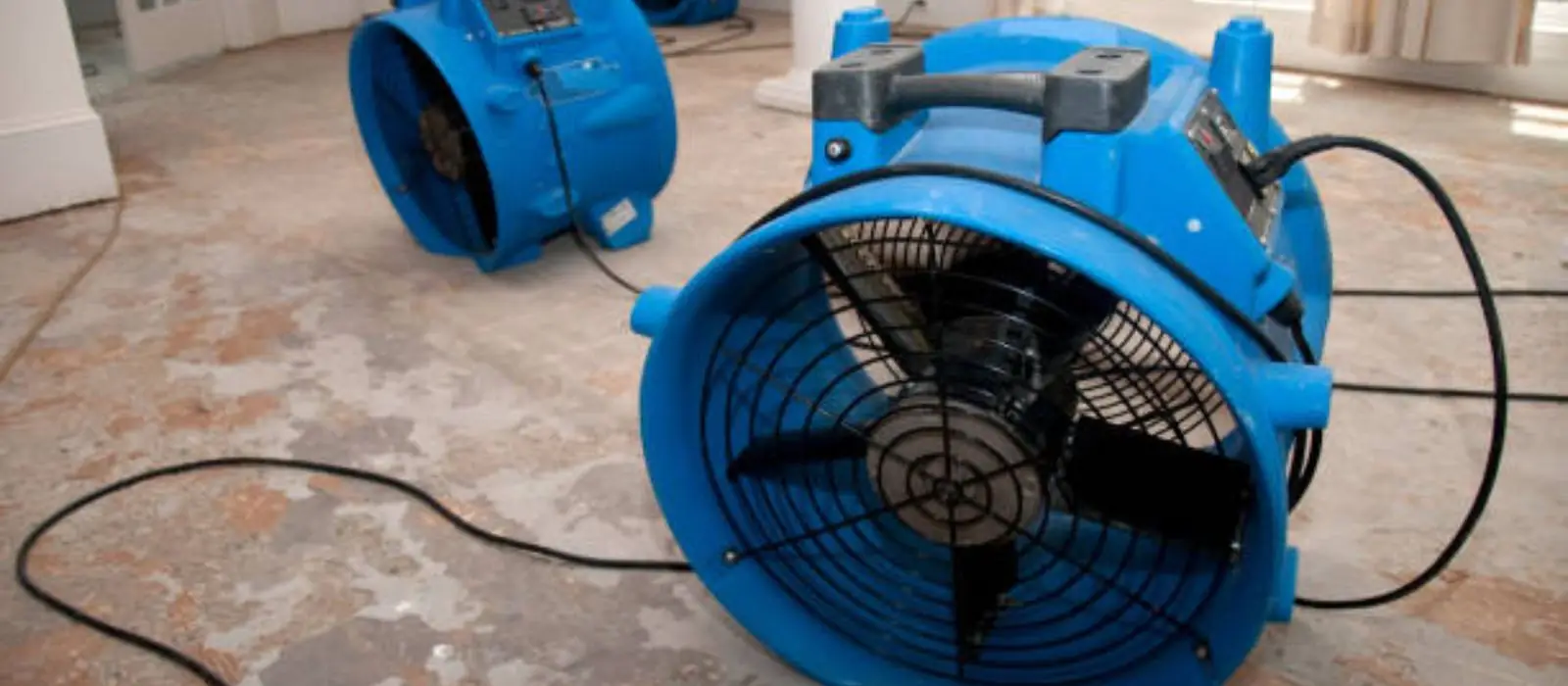
Drying days and equipment are the third piece. Drying uses air movers and LGR dehumidifiers with daily moisture readings, and it continues until the readings reach the target. More days with more units means a higher equipment line on the invoice.
Scenarios and which drivers dominate
These descriptions show where the money goes in four common losses. They are not prices, only a way to see the drivers at work.
| Scenario | Likely category | Dominant cost drivers | What to ask |
|---|---|---|---|
| Small supply-line leak, one room | Category 1 | Extraction, a few days of drying, limited baseboard and drywall work | Can the wall be dried in place? |
| Ceiling leak from above | Category 1 or 2 | Insulation and drywall replacement, texture and paint match, access to the source | Who finds and fixes the source? |
| Basement seepage after heavy runoff | Category 2 or 3 | Large floor area, wet lower walls, longer drying, flooring and carpet removal | What stops the water from returning? |
| Sewage backup | Category 3 | Removal of porous materials, sanitizing, disposal, full rebuild of affected areas | How is contaminated material handled? |
Driver four: demolition and rebuild scope
Demolition is where mitigation meets repair. The more material that must come out, the more there is to put back. A small flood cut along a wall is far cheaper than removing a whole room of drywall and flooring.
Rebuild scope includes new drywall, taping, texture, primer, paint, trim and flooring. Matching an existing texture or a discontinued floor can add labor. Choosing higher-end finishes will move the total as well, and that part is your decision rather than a cost of the water.
Want a real number for your home? Call us and we will schedule an inspection and put the scope in writing.
☎ Call (385) 988-9410Permits and inspections may apply to larger rebuilds. Ask your city building department what applies to your project instead of assuming.
Why a written scope with line items protects you
A written scope lists each room, each material removed, each piece of equipment and each rebuild task. It lets you compare two bids on equal terms and shows your insurer exactly what was done.
Look for line items for extraction, demolition, drying equipment with days, disposal, and each rebuild step. Vague phrases like "water damage work" hide the details that decide the price. If a company will not itemize, treat that as a warning sign.
What a good scope should show
Rooms and materials affected, with the water category noted
Equipment type and the planned number of drying days
Demolition and disposal tasks listed on their own lines
Rebuild tasks listed separately from mitigation
If you have homeowners coverage, share the scope with your insurer and read our overview of what we do to see how the phases fit together. Your insurer decides coverage, not the contractor. Homeowners in Payson and Springville face the same cost drivers.
Spanish Fork note: irrigation lines, sewer laterals and frost
Spanish Fork's pressurized irrigation system typically runs from mid-April to mid-October, and the owner is responsible for the line beyond the first fitting after the meter. A break past that fitting is on your side of the line, so know where your shutoff is before irrigation season starts.
For sewer, the city is responsible for the main up to the property line and the owner for the lateral from the property line to the building, including clearing it. A backup caused by a clogged lateral usually means Category 3 water and the higher-cost column of work, so ask your city utility who handles what before you call a plumber.
Census data puts the median owner-occupied home value in Spanish Fork at $481,500, so a missed leak behind a wall is an expensive way to learn where your shutoff is. Find the main shutoff before you need it.
Source types: City of Spanish Fork Water Division and Public Works pages, City of Spanish Fork building and design criteria
Frequently asked questions
We do not publish per-square-foot numbers because the water category, materials and drying days change the result too much. Call for an inspection and a written scope.
Category 3 water means porous materials are removed and areas are sanitized. That adds demolition, disposal and rebuild.
Drying can be less invasive when materials can be saved. Whether it works depends on category, time and the material.
Often they are scoped and invoiced as two phases. Ask for them separated on paper.
It may, if the loss is sudden and accidental. Check your policy and ask your insurer, since coverage and deductibles vary.
The owner is responsible for the pressurized irrigation line beyond the first fitting after the meter. Locate your shutoff before irrigation season and ask the city if you are unsure where the fitting sits.