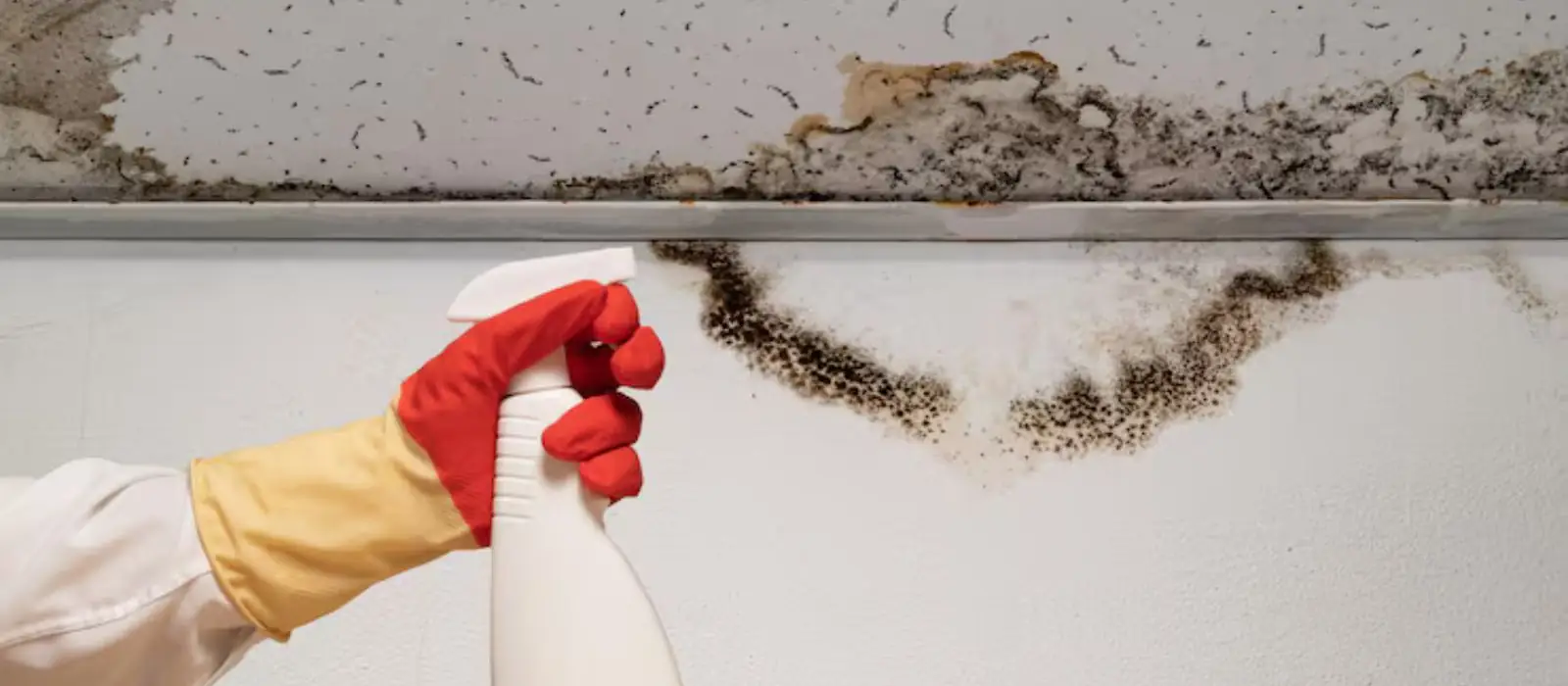
What early ceiling growth looks like
Early growth often starts as small dark specks or a faint gray-green shadow. Over days or weeks it can spread into larger patches, sometimes in rings or clusters. Ceiling paint may bubble or stain yellow around the spot.
A musty, earthy smell that stays after cleaning is another early sign. So is paint that peels in a damp corner, especially near an exterior wall.
One caution matters here. Dark or black-looking growth is not automatically a specific species. Color alone cannot tell you what it is, and only laboratory testing identifies it. Treat any suspicious growth as a moisture problem first.
What you see versus the likely cause
| What you see | Likely moisture cause | Where to look |
|---|---|---|
| Dark spots in a bathroom ceiling corner | Weak exhaust fan or steam with no vent path | Fan duct, fan output, door gap |
| Dark ring around a stain on a top-floor ceiling | Roof leak or failed flashing | Attic decking, roof penetrations, insulation |
| Speckling along the line where wall meets ceiling | Condensation on a cold exterior wall | Insulation gaps, window frames |
| Dark patches under a bathroom or kitchen above | Slow plumbing or fixture leak | Supply lines, drain connections, tub seals |
| Growth near a vent or register | Condensation on ductwork | Duct insulation, cooling use |
| Musty smell, no visible spot | Hidden damp insulation above the ceiling | Attic or ceiling cavity |
Match the pattern to your room, but expect more than one cause to be at work.
Why moisture is the real issue
Mold needs moisture. Without a damp surface, growth stalls. Scrubbing a ceiling spot without addressing the wetness is why stains often come back.
That means the question to ask is not only what is growing but why the ceiling is damp. A roof leak, an underperforming exhaust fan, or condensation on a cold surface are the common answers.
If there has been an active leak, the wet material above the ceiling matters as much as the visible spot. Insulation and drywall can stay wet long after the drip stops.
Testing, health and what we do not say
Testing is the only way to identify what is growing. A sample or air test, interpreted by a qualified lab, can tell you more than color ever will. Whether to test depends on the situation, and a remediation company can explain your options.
We do not diagnose health issues. If anyone in your home has symptoms or concerns, those questions belong to a physician.
Remediation follows ANSI/IICRC S520, a published industry standard. Ask any company whether its crews work to it.
What to do right away
- Find and stop the moisture if you can, such as a dripping fixture or a closed bathroom door during showers.
- Photograph the area and mark its edges with a pencil so you can see whether it grows.
- Turn on exhaust fans and open a window during bathroom use.
- Keep children and pets out of the room if you want to be cautious.
- Avoid dry brushing, sanding, or spraying, which can spread material.
- Call a professional for anything larger than a small spot.
Not sure what you are looking at? Call us and we can walk through what you see, then arrange an on-site assessment.
☎ Call (385) 988-9410When to call and when not to touch it
Call a professional when the growth covers a large area, returns after cleaning, sits above a known leak, or the ceiling is sagging. Also call if the smell persists with no visible source, since hidden damp insulation may be involved.
Do not scrub or scrape a large area. Disturbing growth on a ceiling can release material into the room and spread it to clean surfaces. A professional sets up containment first, and uses HEPA air filtration while the work happens.
Ceiling drywall that is soft, stained all the way through, or sagging usually needs removal, not cleaning. Porous materials are harder to clean than sealed ones. Our mold remediation service covers that work.
Fixing the source: roof, fan, or condensation
A roofer or plumber handles the leak, an HVAC or exhaust specialist handles the fan or duct, and a restoration crew handles the damaged materials. The order matters: stop the water, dry the materials, then remove and rebuild what cannot stay.
If a roof leak soaked the ceiling, a restoration crew can also address the wet insulation and drywall. Our water damage repair team rebuilds the finish once the material has dried.
Spanish Fork note: owners, roofs and permits
With 80.4% of Spanish Fork housing owner-occupied, most ceiling leaks are the homeowner's to trace and repair. If the roof is the source, a quick look at the attic after a storm can help you catch a damp spot early, before it reaches the ceiling below.
For significant repairs that involve structure or finish work, contact Spanish Fork Building at 40 S Main St and ask whether the work needs a permit or inspection. The city office can answer that, so we do not guess.
Census figures put owner-occupancy in Spanish Fork at 80.4 percent, so most ceiling repair decisions and insurance claims belong to the homeowner rather than a landlord. Document the stain with photos before you patch anything.
Source types: US Census Bureau, Spanish Fork Building, city structural design criteria
Frequently asked questions
No. Color does not identify a species. Only laboratory testing does. Treat any dark growth as a sign of moisture and have it assessed.
A tiny surface spot on a sealed, nonporous area is sometimes within DIY reach if the moisture source is fixed. Ceiling drywall is porous, so a growing or recurring spot should be assessed.
Mark the stain edge and check after rain, showers or laundry. If it grows, the source is active. A moisture meter gives a firmer answer.
No. Paint covers the surface but not the moisture, and growth can reappear. Find the source and have the area assessed first.
Not always. Testing can help in some cases, and a remediation company can explain whether it fits yours. Remediation itself follows ANSI/IICRC S520.
Ask Spanish Fork Building at the city office, 40 S Main St. They can say whether your repair needs a permit. We also serve Salem and Springville homeowners facing the same question.